Phoenix-Area HVAC Companies Web Design
Custom web design for HVAC companies across the Phoenix metro. Built to rank locally, convert visitors, and win more installs and service calls.
Why Phoenix HVAC Companies Can’t Afford a Weak Website
HVAC is one of the most competitive service categories in the Phoenix metro. When a homeowner’s AC quits in July, they are not flipping through a phone book. They are grabbing their phone and searching. What they find in the next thirty seconds determines which company gets the call, and usually the job. If your website looks outdated, loads slowly, or buries your phone number, that customer is already on your competitor’s site.
I build websites through Carter Pixels for exactly this situation. Not brochure sites that just list your services, but real lead-generation tools that are fast, easy to navigate on a phone, and built to show up when local customers search. Industry data makes the mobile case clearly: more than 64% of HVAC website queries happen on a mobile device, which means a site that is hard to use on a phone is not a minor issue, it is a business problem. [1]
Beyond mobile, the design itself has to do actual selling work. Strong calls-to-action, easy navigation, and a layout that moves a visitor toward your phone number are the things that turn traffic into booked jobs, not just page views. [2] A pretty site that does not convert is just an expensive placeholder.
Recent build
A relevant project from my portfolio.
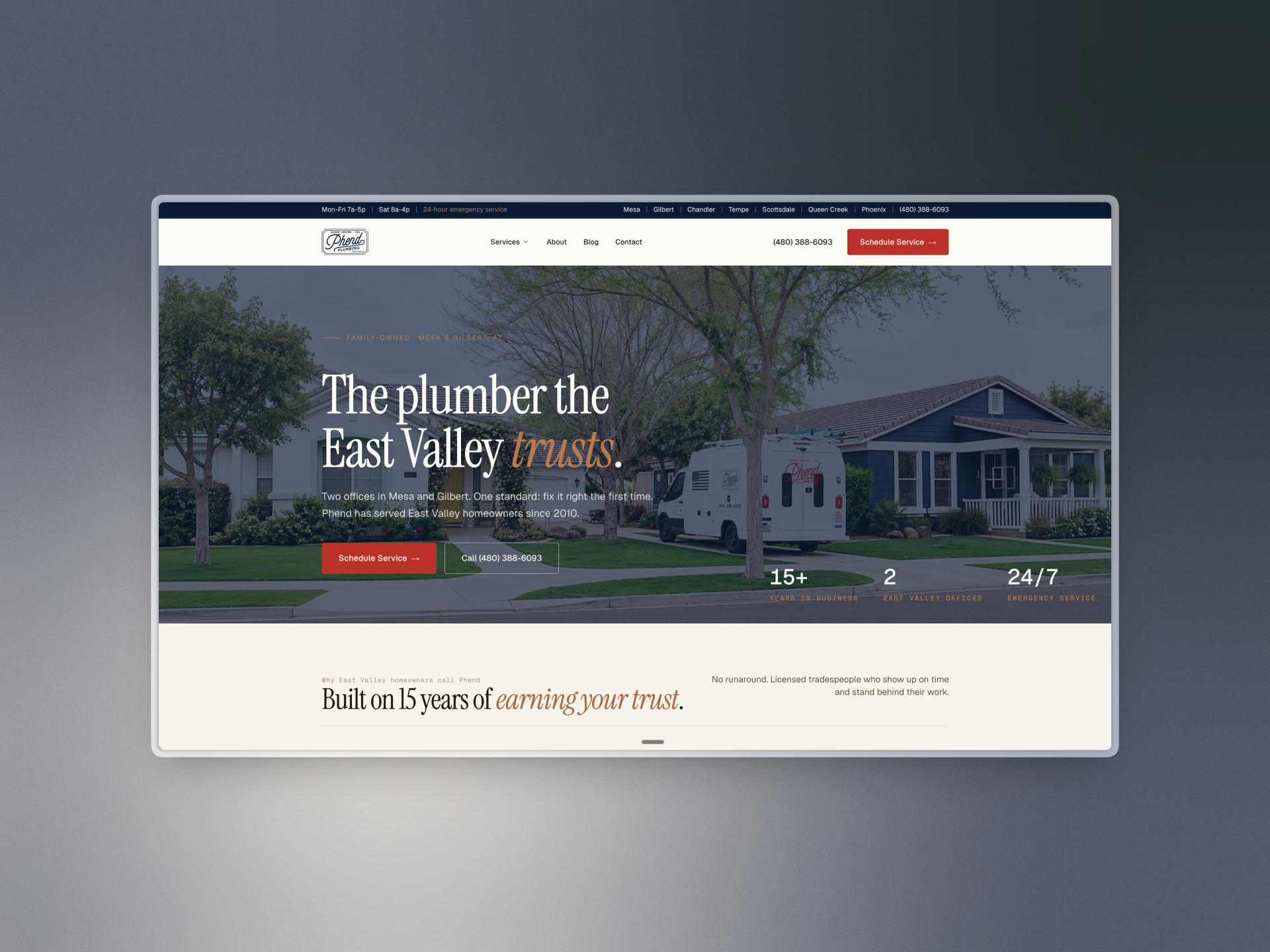
Phend Plumbing
Full WordPress-to-Astro migration for a family-owned plumber: design system, SEO architecture, and 538 URL redirects with zero ranking loss.
What a High-Performing HVAC Website Actually Needs
I have looked at a lot of HVAC sites across the Valley, and the gaps tend to cluster around the same handful of things. Here is what I focus on when I build one from scratch:
- Clear service pages. One page per core service, written plainly and structured so Google understands what you do and where you do it. AC repair, installation, heating, duct work, maintenance plans, whatever your business actually offers. Lumping everything onto one page is a missed opportunity, both for search rankings and for the customer trying to confirm you handle their specific problem.
- Location-specific pages. Phoenix is enormous, and people search hyper-locally. A homeowner in Gilbert searches differently than one in Peoria. Separate, well-built city pages let your site compete across the whole metro instead of just in one pocket.
- Trust signals up front. Licenses, years in business, review counts, real photos of your team and trucks. These things matter to a homeowner deciding between three companies in about ninety seconds. A generic stock-photo site with no personality loses that comparison almost every time.
- Speed and mobile usability. This is non-negotiable. A slow site bleeds visitors and hurts rankings. Every site I deliver is tested for load performance and built to work cleanly on the devices your customers are actually using.
- A frictionless path to contact. Click-to-call in the header. A short, fast quote form. No buried contact pages. The easier you make it to reach you, the more people will.
You can see this kind of thinking applied in my recent builds. The one most directly comparable to HVAC work is Phend Plumbing, a site I built for a family-owned plumber. Same trade-services audience, same local trust dynamics, same need for a site that earns confidence quickly and then gets out of the way so the phone can ring.
What I Do Differently at Carter Pixels
I am a one-person studio, which means when you work with me, you are talking to the person actually building your site. There is no account manager passing your notes to a designer you will never meet. I handle the strategy, the design, the copy structure, and the build myself.
That also means I am selective. I work with established local businesses that are ready to invest in something built properly, not the cheapest option on the market. If you want a template thrown up in a weekend, I am genuinely not the right fit. If you want a site that reflects the quality of your business and is built to bring in work consistently, that is what I do.
For HVAC companies specifically, I build with local search in mind from the first wireframe, not bolted on afterward. Service-area pages, proper heading structure, fast-loading images, schema markup for local businesses. The goal is a site that earns its keep every month, not just looks good at launch.
Browse the city pages below to find the page most relevant to your service area, or look through my recent builds to get a sense of how I approach this kind of work.
Frequently asked questions
Templates are generic. A custom site is built around how HVAC customers actually search and decide, with service pages, local SEO structure, and calls-to-action placed where they do the most work. It also gives you a real edge over competitors still running outdated or cookie-cutter sites.
At minimum: a homepage that clearly states your service area, dedicated pages for each core service (AC repair, installation, heating, etc.), a reviews or trust section, and a fast way to request a quote or call. City-specific landing pages matter a lot for local search visibility across a spread-out metro like Phoenix.
Design and SEO are tied together. Things like page structure, load speed, mobile responsiveness, and internal linking all influence how Google crawls and ranks your site. A slow or poorly built site can hurt your visibility even if your services are excellent.
Absolutely. Industry data shows more than 64% of HVAC website queries happen on a mobile device, so every site I build is designed mobile-first. That means fast load times, thumb-friendly navigation, and a click-to-call button that is never more than a second away.
Yes, completely. The site is yours from day one. No lock-in clauses, no surprise fees if you ever want to move hosts or make changes on your own.