Phoenix-Area Law Firms Web Design
John Carter builds custom websites for Phoenix-area law firms that look credible, rank locally, and turn visitors into consultations. Carter Pixels, solo web design.
Why Phoenix Law Firms Can’t Afford a Weak Website
Law is one of the few industries where a bad website doesn’t just cost you clicks. It costs you trust. Someone dealing with a divorce, a DUI, a business dispute, or an estate is already stressed. When they land on your site, they’re making a fast judgment call about whether you’re the kind of attorney they want in their corner. If the design looks dated, the bios are vague, or the phone number is buried, they’re gone, back to the search results and onto the next firm.
The Phoenix metro is a competitive legal market. Family law, personal injury, estate planning, criminal defense, immigration, every one of those practice areas has dozens of firms competing for the same searches. According to industry guidance from Attorney at Law Magazine, the best law firm websites share a few common traits: they establish credibility immediately, make it obvious what the firm does and who it serves, and remove every possible barrier between a visitor and a consultation. That last part matters more than most attorneys realize. Research from MyCase found that firms using optimized lead capture on their websites saw an 18% lead conversion rate, which is a meaningful number when each new client relationship can be worth thousands of dollars.
A website that doesn’t convert isn’t a neutral thing. It’s actively working against you.
Recent build
A relevant project from my portfolio.
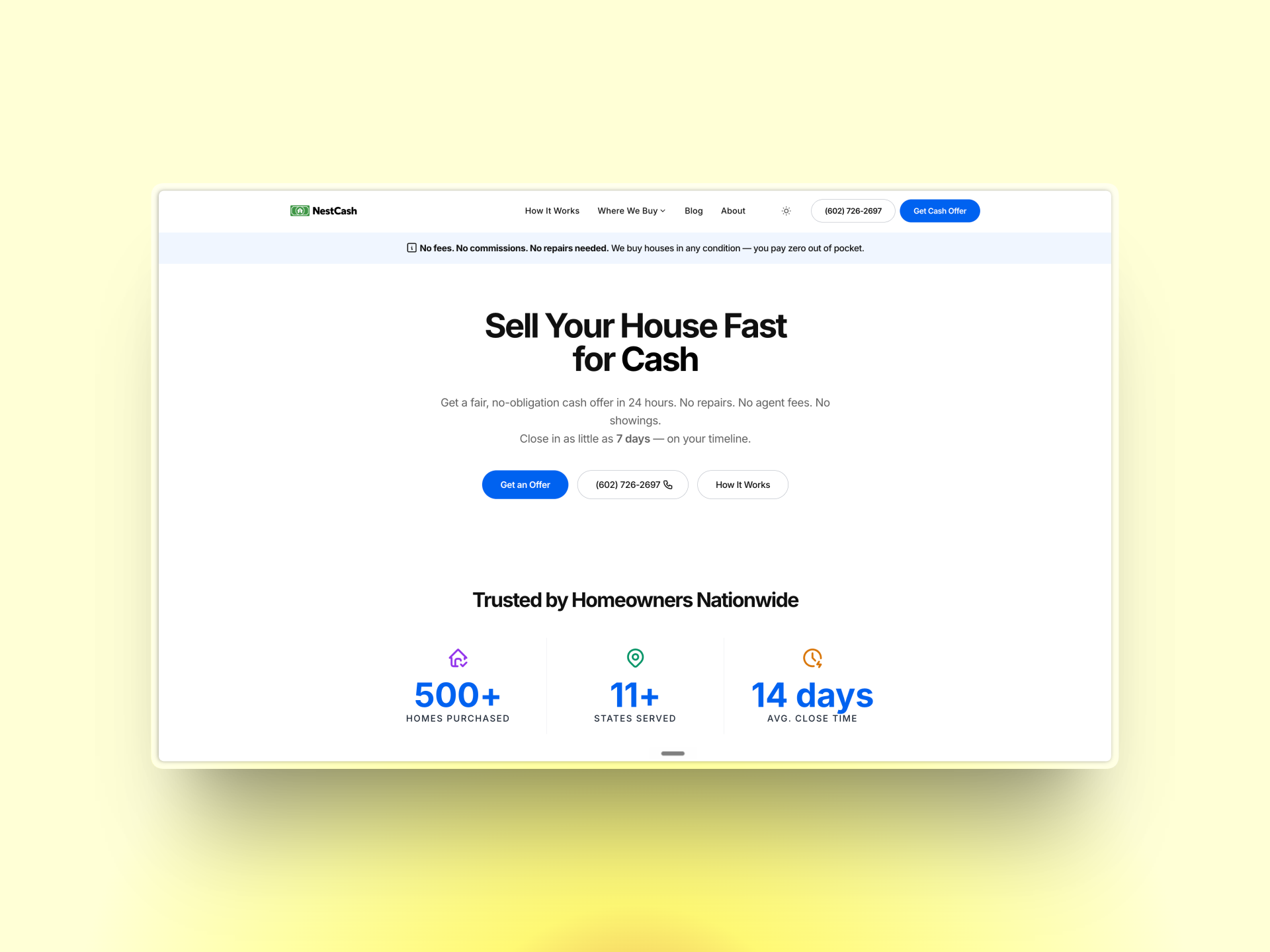
NestCash
An automated SEO content engine for cash home buying: 70 city pages, 273+ articles, and a dual pipeline that publishes daily.
What a Law Firm Website Must Do to Win Work
Here’s my honest take: most law firm websites fail not because they look bad, but because they were built to check a box rather than to serve a real business goal. The attorney wanted something online, they used a template or a budget service, and the result is a site that technically exists but does almost nothing.
A site built to actually win clients needs to do several specific things:
- Dedicated pages for each practice area, written in plain language that speaks to the person with the problem, not to other attorneys.
- Attorney bio pages with real photos and a genuine sense of who you are.
- A contact form and phone number on every page, not just the contact page.
- Local SEO built in from day one, with location-specific content that connects your firm to the specific cities and neighborhoods you serve across the Phoenix metro.
Beyond that, the site has to load fast on mobile. A huge share of people searching for legal help are doing it on their phone, often in a stressful moment. A slow, clunky mobile experience is a serious problem.
This is the kind of thinking I bring to every project at Carter Pixels. I’m not a legal industry specialist in the sense that I only work with law firms, but I understand how service businesses earn trust online, and law firms are fundamentally trust businesses. You can see how I approach professional-services design in the Mattur project, a B2B site where the entire challenge was communicating credibility and clarity to a skeptical, sophisticated audience, which is exactly what a law firm website needs to do.
What I Do Differently
I build custom websites. Not templates with your logo swapped in. Not a WordPress theme with your practice areas dropped into placeholder text. Every site I build starts from your firm’s specific situation: who your ideal clients are, what practice areas you want to grow, what markets across the Phoenix area you’re targeting, and what your current site is getting wrong.
Because I work solo, you deal directly with me through every stage. There’s no account manager relaying messages to a developer you’ll never talk to. When you have a question or want to adjust direction mid-project, you get a direct answer fast. You can browse my recent builds to get a feel for the quality and care I put into each one.
I’m also straightforward about what a website can and can’t do on its own. A great site is the foundation. It gives you something worth sending people to, something that converts visitors into consultations. But it works best when it’s paired with a solid local SEO strategy and a Google Business Profile that’s properly maintained. I can help you think through all of that, not just hand you a finished site and disappear.
If you’re an established Phoenix-area law firm that’s serious about your online presence, I’d be glad to talk about what a purpose-built website could do for your practice.
Frequently asked questions
Templates look like every other firm on the block. A custom site reflects your specific practice areas, your attorneys' personalities, and the clients you actually want to attract. In a high-trust field like law, a generic site quietly signals that you haven't invested in your own presentation, and potential clients notice.
At minimum: a clear homepage that states who you serve and where, individual practice area pages, attorney bio pages with real photos, a contact page with a prominent phone number and intake form, and a client resources or FAQ section. Each practice area should have its own page so Google knows exactly what you do.
Extremely. Most people searching for an attorney type something like 'family law attorney Scottsdale' or 'criminal defense lawyer Chandler.' Your site needs to be built from the ground up with location-specific content, proper schema markup, and Google Business Profile alignment to show up for those searches.
For a well-built custom site, plan on roughly six to ten weeks from kickoff to launch. That includes strategy, copywriting direction, design, development, and revisions. Rushing it tends to produce a site that looks unfinished, not a great first impression for a firm asking people to trust you with serious legal matters.
Yes. Search engines favor sites with fresh, relevant content. A blog covering common legal questions in your practice area, updated attorney bios, and current case results (where ethics rules allow) all signal that your firm is active. A stale site from 2018 tells Google, and prospective clients, that nothing is happening.